

In shortAccording to engineer Pavel Tolstiy, he built an electric car on an old Porsche almost single-handedly: it took about 6,000 hours of engineering, it makes around 650 horsepower, and it goes from 0 to 62 mph (100 km/h) in 3.2 seconds. Such cars, he says, start at $350,000, and he makes four to six a year. He says he learned the field from YouTube, spending five years on CAD, mechanics of materials, C++ and electronics, and he turned down a job at Tesla.
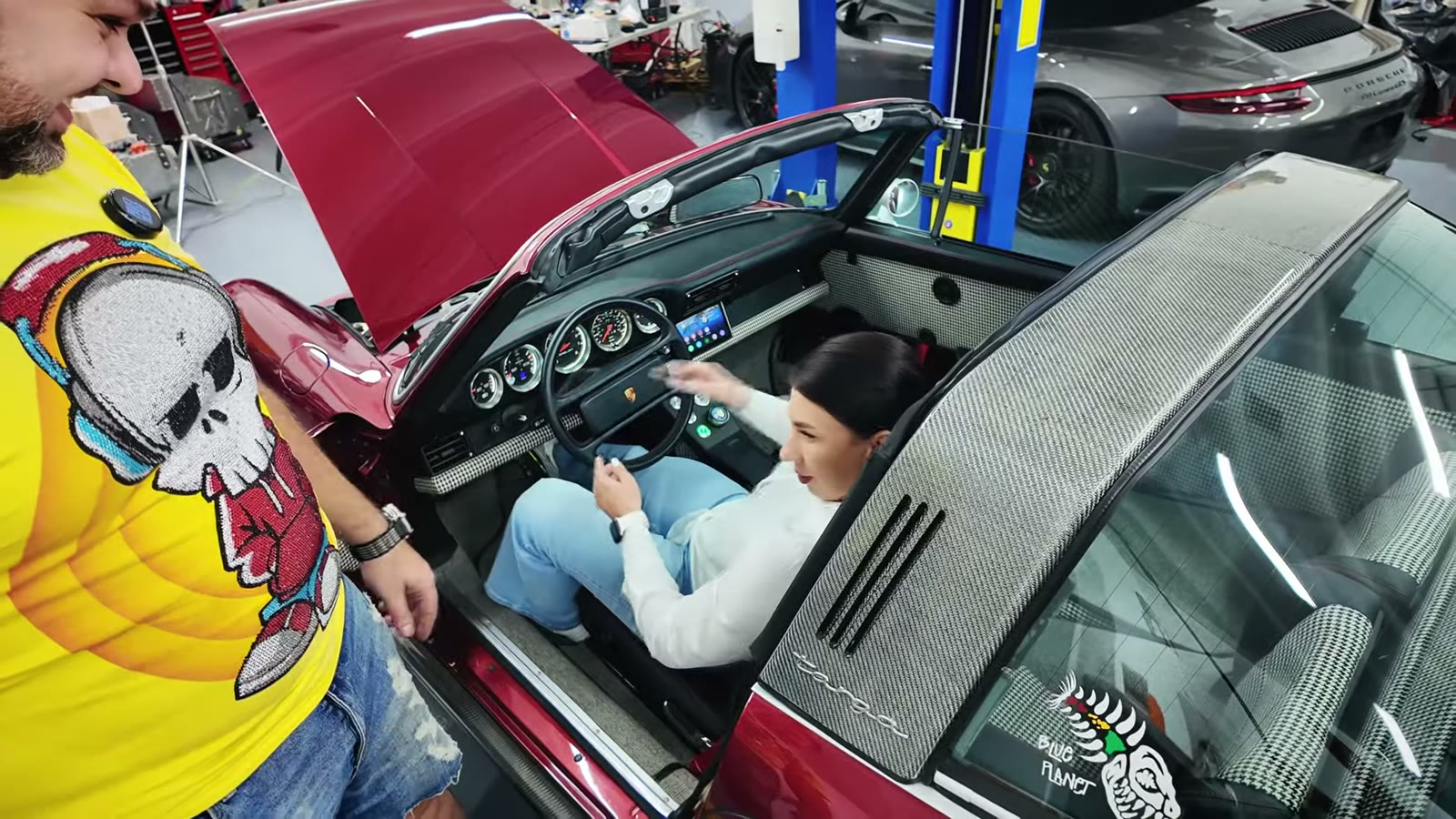
I’m sitting behind the wheel of a Porsche that’s more than forty years old. Pavel tells me to turn the key on the left, and from there it’s like any other car: warning lights come on, the needles wake up. I’m waiting for the roar of an engine, but all I hear is a soft purr. “So there won’t be any sound?” I ask. The sound, he explains, comes from speakers, and it’s there not for the feel but for safety: in the city, pedestrians can’t hear an electric car.
This car, which looks like a classic, is actually an electric car. One man built it, and he has no engineering degree. I’ve always wondered how that’s possible: can you become an electric car engineer without formal training, what does an electric restomod on an old Porsche cost, and should you believe the people who say “impossible”? So I went to Pavel Tolstiy’s garage. We usually record over a cup of tea, but this time the atmosphere was pure garage. And while we talked, a cat named Pixel wandered around the shop, whom Pavel calls his head mechanic and head tester.
Can you become an electric car engineer from YouTube, without a degree?
On paper, Pavel is a specialist in international finance. He’s been around cars for a long time: back in Ukraine he raced, drifted and drag-raced, took engines apart himself and tuned control units, because hired mechanics, in his words, always leave a safety margin: they’re afraid to break something. And to win, you need every last hundred percent.
He only started studying engineering after he moved to America, when he needed a part for an old Corvette that couldn’t be bought. I asked him where he got that knowledge, and heard an answer that comes up in our conversation more than once.
However funny it sounds, YouTube.Watch this moment · 15:00
It took him five years, Pavel says, to get a handle on CAD, mechanics of materials, thermodynamics and airflow. He learned the C++ language to write the control units, taught himself to design circuit boards, and got into 3D scanning. He says he didn’t spend a penny on his education: the money went into experiments and equipment, about $60,000–70,000 worth.
Listening, I recognized myself. Pavel pointed out that I too learned how to hold a conversation, pick questions and keep timing from YouTube videos, and I didn’t argue. “Good students become good employees, and self-taught people become employers,” he said, and with that line I could probably close an entire chapter on education.
Кадр из выпуска «Без границ»What does an electric car on a Porsche cost, and how is a restomod made?
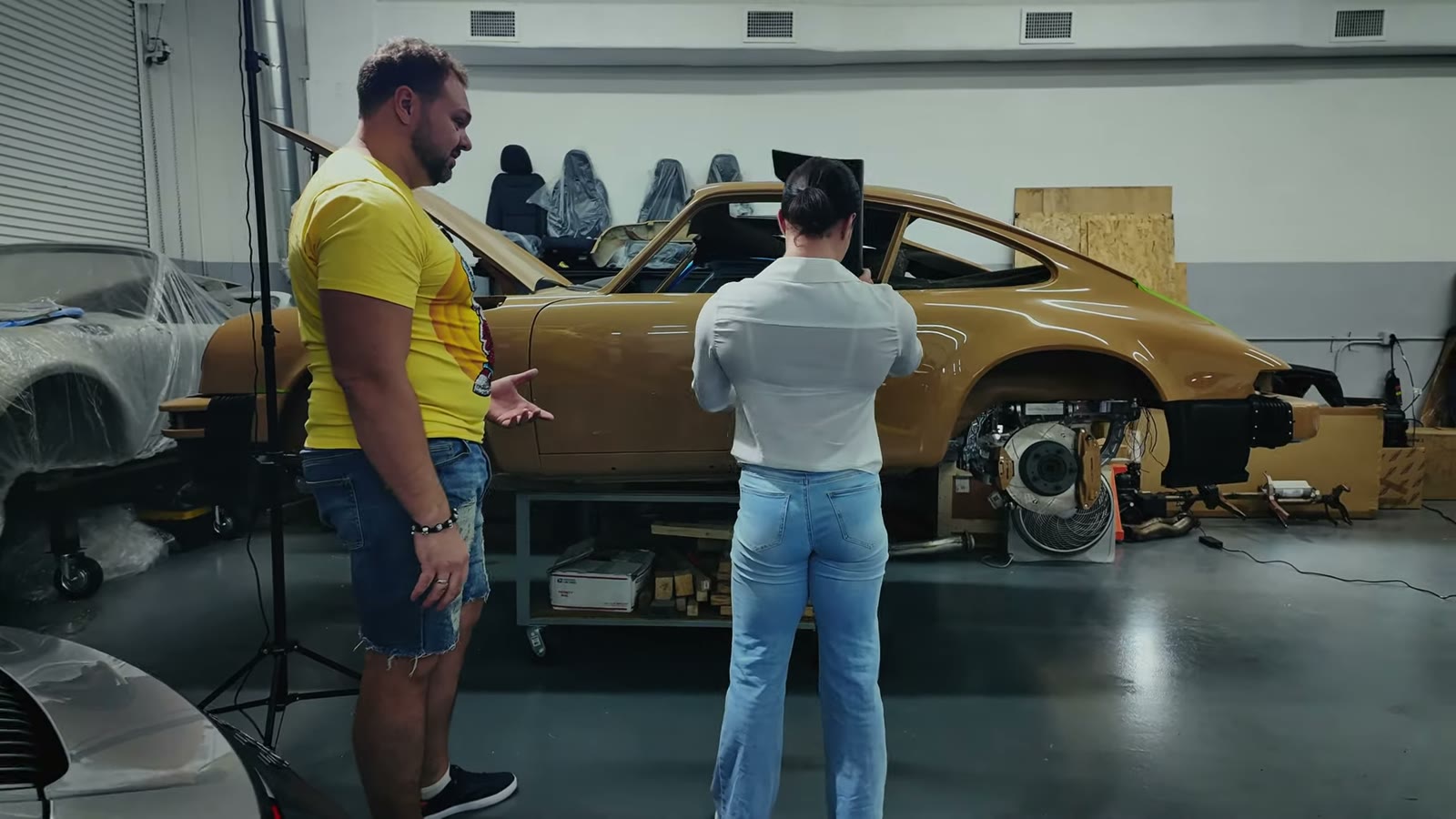
These cars are called restomods: an old body with new guts. It isn’t a copy but an attempt to keep the classic look and give it a modern life. Everything technical in this Porsche, Pavel says, he developed from scratch: the rear suspension, battery packs, brakes, steering, ABS and traction control. About ten percent of the original parts are left. Even the air conditioning for the high-voltage battery he had to make himself: a ready-made one simply doesn’t exist.
The car makes around 650 horsepower and goes from 0 to 62 mph in 3.2 seconds. Even Pavel finds that a little scary: by his own account he never drives it at more than 45% of its power. And when one client wanted two cars, one for himself and one for his wife, Pavel promised to build in a power setting: otherwise, as the client put it, “my wife will get herself killed.”
I couldn’t resist asking how much a car like this costs if I wanted a Porsche with an electric heart. “We start at 350,” Pavel said, meaning thousands of dollars. Similar projects elsewhere in the world, he says, start at $800,000, but those have entire workshops and design offices behind them. Here, he’s on his own: his partner puts up the money, and he puts in the knowledge.
Why so little handwork? Pavel sums it up in one sentence that stuck with me.
Manual labor is a mistake.Watch this moment · 25:18
A person can show up in a bad mood and tighten a bolt wrong, and then the client pays for it. That’s why almost everything in the car is made on machines from drawings: he draws a part, sends the file to a factory and gets it back already bent and welded. A battery pack that took him a month to build by hand the first time can now be assembled by an ordinary person in three days.
 Кадр из выпуска «Без границ»
How do you find work as a mechanic in the US if you’re a professional?
Pavel came to America in November 2014. The first thing he did was go to the owner of an auto shop and name a figure: an ordinary mechanic then made $12–15 an hour, and he wanted $25. The owner gave him a test: two brand-new Toyota Tundras to build in forty days for the Paris–Dakar rally. Pavel had never worked on that model before, but he built both. The trucks flew off to the race, where the driver, despite a warning, jumped them a foot and a half in the air for a photo, and nothing broke.
From that story he draws a conclusion everyone thinking about moving should read.
You should come here as a professional at something.Watch this moment · 11:52
If you, let’s say, did “buy and sell” back home, there are a million people like you here. America needs professionals in every line of work: cosmetology, auto building, repair, sports. I clearly remember my own “reset to zero” in my first months in the US, and I know how much it counts here when you can do something with your hands and your head.
 Кадр из выпуска «Без границ»
Why did the engineer turn down a job at Tesla?
About two years ago, a Tesla recruiter wrote to Pavel: they’d heard about his work and were inviting him to head a division. According to Pavel, the head of such a department earns $140,000–180,000 a year there. Pavel turned it down all the same, for several reasons. He learned that working conditions at Tesla are very tough: the schedule, the discipline, hardly any concept of days off. And he’s a creative person: his brain works best from four in the afternoon to six or seven in the morning, so he draws at night and works with his hands during the day.
His work week is 60–70 hours. “Money doesn’t fall from palm trees,” he laughs. And he’s honest that the load can be unbearable: once, he says, he sat at the computer for six hours in front of a blank screen, and his wife said, “I think that’s enough.” As for the air-conditioning unit, he thought about it for two months; the idea came while he was in the shower or walking to the store, and then he drew it in two days.
Pavel now believes his knowledge is worth more than his hands. This is his last project in this format; next he wants to build an engineering department: his team of five works from Ukraine, and he pays his CAD engineers $15 an hour, while the going rate there is $6–10. He won’t be training newcomers anymore, he says: of three attempts, one worked.
What are the downsides of electric cars and of Tesla?
I asked point-blank whether electric cars have downsides. “Safety and charging,” Pavel said, even though his wife drives a Tesla Model Y and he likes it a lot. Slow charging over eight hours, he explains, is almost never dangerous. But fast charging at Superchargers heats the battery more, and the fire risk is higher. Tesla uses lithium-ion cells, which charge quickly and deliver a lot of power but run hotter. Lithium-polymer cells, such as LG’s, run cooler, and Chinese makers use lithium iron. Each chemistry has its pros and cons.
So why doesn’t he drive his own car? Because, he says, he’s still far from Tesla’s level, and it’s not about speed: Tesla has a whole factory of engineers working on the interface, charging and navigation, on everything that creates comfort. To him, a Tesla is “like a phone”: you get to work, plug it in, and it updates itself. Getting his car to even ten percent of that comfort, he believes, will take years.
Pavel sees a big future for electric cars. He names hydrogen cars as the nearest competitor, but hydrogen, as a Toyota engineer told him at the SEMA show in Las Vegas, is very hard to transport and expensive to produce.
What I take away from this conversation
I feel like I became a bit of an engineer myself during that hour. But what stayed with me more was something else: Pavel simply didn’t believe it couldn’t be done. When he showed engineers the drawings of his rear suspension, which took him four months, they told him one person can’t do that in so little time. And he did.
If someone tells me it’s impossible, I’ll do it anyway.Watch this moment · 1:00:34
And one last thought I’ll carry with me: everyone, wherever they live, has the same access to YouTube and to all that information as Pavel does. It comes down to wanting it enough to pick a direction and start.
If you dream of building something of your own in the US, watch the full episode; it’s in Russian, and YouTube can auto-translate the subtitles into English. Our entire conversation, word for word, is on the next page.





 Kristina Samofal
 Photo & Video Production